Over the past few years, the conversation around electric vehicles (EVs) in Europe has changed dramatically.
Not long ago, most consumers were asking the same questions: Are electric cars too expensive? Can they travel far enough on a single charge? Will the battery still perform well after several years? Those concerns dominated almost every buying decision.
Today, the situation looks very different.
Thanks to continued advances in battery technology, a growing number of affordable EV models and the rapid expansion of charging infrastructure, electric mobility is becoming more accessible than ever before. From compact city cars to family SUVs, European drivers now have far more choices than they did only a few years ago.
Yet while vehicle technology has improved significantly, a new challenge has quietly become the deciding factor for many first-time buyers.
Instead of asking "Which electric car should I buy?", more people are asking "How will I charge my electric vehicle every day?". That shift may seem subtle, but it represents one of the biggest changes in Europe's EV market.
Buying an electric vehicle is a one-time investment. Charging it, however, becomes part of your daily routine. If charging fits naturally into your lifestyle, owning an EV feels convenient and economical. If it doesn't, even the most advanced electric vehicle can quickly become frustrating.
This is why EV charging is becoming just as important as driving range, vehicle performance and purchase price. For many European households, charging anxiety has already replaced price anxiety.
😖Why Charging Anxiety Is Replacing Price Anxiety?
Only a few years ago, high purchase prices were the biggest obstacle preventing many European consumers from switching to electric vehicles. Manufacturers have since introduced more affordable models, governments continue to invest in charging infrastructure, and financing options have become more flexible. While prices still vary between brands and countries, electric vehicles are no longer viewed as products exclusively for early adopters or premium buyers. As these traditional barriers continue to fall, attention is shifting toward a far more practical question:
How easy will it be to charge an EV where I live?
Unlike refuelling a petrol or diesel vehicle, charging an electric vehicle depends heavily on individual circumstances. Two neighbours driving exactly the same car may have completely different ownership experiences.
One driver arrives home every evening, parks on a private driveway and plugs into a Home EV Charger. By the next morning, the battery is fully charged with almost no effort. The other parks several streets away, depends entirely on Public EV Charging and needs to check charging apps before deciding where to stop after work.
Both own the same vehicle, only one enjoys a stress-free charging experience.
That is why charging anxiety has become less about the vehicle itself and more about everyday life. In Europe, your charging experience is often determined long before you purchase your first EV.
It is determined by your home. Your parking situation determines your charging experience.
When people begin searching for the Best EV Charger, they often compare charging power, smart features or price. While those factors certainly matter, they are not the best place to start. The first question every future EV owner should ask is much simpler:
"Where will my car spend most nights?"
The answer to that question usually determines which charging solution will make the most sense. Across Europe, most EV owners can be grouped into four common living situations. Understanding which one applies to you is far more valuable than comparing technical specifications alone.
🔋1.Private Driveway or Garage: The Ideal Home Charging Experience
For homeowners with a detached house, townhouse, private driveway or garage, charging an electric vehicle is usually the simplest part of EV ownership. Once a Home EV Charger or EV Wallbox has been installed, charging naturally becomes part of the daily routine. There is no need to drive to a public charging station after work or worry about whether chargers are available nearby. Simply park the vehicle, connect the charging cable and let the car recharge overnight. The next morning, the battery is ready for another day.
It also delivers the lowest charging costs.
By taking advantage of off-peak electricity tariffs, many households significantly reduce their cost per kilometre compared with relying on public charging. Those who have rooftop solar panels can reduce costs even further by charging with self-generated electricity. As a result, many new EV buyers are now searching for Home EV Charging Cost and asking "Is home charging cheaper than public charging?" before choosing a charging solution.
For homeowners, the answer is almost always yes.
Charging becomes something that happens naturally while the family sleeps, rather than another task to complete during the day. For this group, charging anxiety is usually minimal because the charging solution fits perfectly into everyday life.
🔋2.Apartment Owners with a Dedicated Parking Space: Home Charging Is Still Possible
One of the biggest misconceptions surrounding electric vehicles is that apartment residents cannot install their own chargers.
In reality, that is becoming less true every year.
Across France, Belgium, Germany, the Netherlands and many other European countries, newly constructed apartment buildings increasingly include infrastructure that supports Residential EV Charging. Existing buildings are also gradually being upgraded as demand continues to grow.
If you own or lease a dedicated parking space and your building allows electrical installation, a Smart EV Charger can often provide almost the same convenience as charging at a detached house.
However, apartment charging introduces a challenge that private homeowners rarely face.
Security and Signal
To prevent unauthorized use of your electricity, you can purchase a wall-mounted charger that requires a password or an RFID card to initiate charging. And if a public parking lot lacks Wi-Fi, it is not an issue; most app-controlled wall chargers can connect via Bluetooth, so the absence of Wi-Fi does not affect functionality.
Note: Electrical capacity, cable routing, property management approval and national regulations all need to be considered before installation begins. Planning these details in advance helps avoid unnecessary costs and delays later.
🔋3.No Dedicated Parking Space: Where Charging Anxiety Is Most Common
While homeowners and apartment residents with dedicated parking spaces can usually find a reliable charging solution, life is very different for millions of Europeans living in busy city centres.
In cities such as Paris, Brussels, Amsterdam, Berlin and Milan, many residents park wherever they can find an available space. Tomorrow's parking spot may be completely different from today's. For these drivers, installing a private Home EV Charger is simply not realistic.
Not because they do not want one.
Because they have nowhere to install one. Without a dedicated parking space, daily charging depends almost entirely on Public EV Charging infrastructure. That usually means relying on residential AC charging stations, workplace charging, destination charging at supermarkets or shopping centres, and DC Fast Charging along motorways for longer journeys. On paper, this may sound like a reasonable solution. After all, Europe now has one of the world's fastest-growing public charging networks.
However, everyday experience often tells a different story. Many first-time EV buyers assume that having more charging stations automatically means charging will always be easy. In reality, availability and convenience are not always the same thing.
Imagine arriving home after work with only 15% battery remaining, only to discover that every public AC charger near your neighbourhood is already occupied. You decide to drive to another charging location a few kilometres away, but one charger is out of service while another has a vehicle connected long after charging has finished.
These situations are not unusual, especially in densely populated cities where EV adoption is growing faster than local charging capacity. This is one of the reasons why more consumers are asking "Is public charging enough for daily driving?" before purchasing their first electric vehicle.
Availability is only one part of the challenge, another common frustration is the variety of charging operators across Europe.
Although interoperability has improved significantly in recent years, drivers may still encounter different mobile applications, payment systems and RFID cards depending on which charging network they use. A weekend road trip could easily involve several charging operators, each with its own pricing structure and user interface. Many new EV owners are therefore asking "Do I need multiple apps to charge my EV in Europe?" or "Which public charging network is best in Europe?" before planning longer journeys.
Charging costs also vary far more than many consumers expect.
Charging at home overnight generally remains the most economical option, particularly when combined with off-peak electricity tariffs. Public AC charging is often more expensive, while DC Fast Charging along major motorways usually carries the highest cost because drivers are paying not only for electricity but also for convenience, infrastructure and network operation. For drivers who rely primarily on public charging throughout the year, these differences can noticeably increase annual running costs. This explains why search interest in EV Charging Cost, Public Charging Cost and Home vs Public EV Charging continues to grow across Europe.
Long-distance travel introduces another layer of uncertainty. During school holidays, Christmas, Easter and the summer vacation period, popular motorway charging locations can become considerably busier than usual. Even where charging stations are available, waiting times are sometimes unavoidable.
None of these challenges suggest that public charging is failing. On the contrary, Europe's public charging infrastructure continues to improve every year and remains essential for making electric mobility possible. However, for drivers who depend on it every day, public charging still requires more planning and flexibility than many people initially expect. This is precisely why charging anxiety is most noticeable among urban residents without private parking.
So, does this mean these drivers have no reason to own a charging device themselves? Not at all.
While a Portable EV Charger cannot replace public charging infrastructure, it can provide valuable flexibility in situations where public charging is unavailable, inconvenient or simply unnecessary.
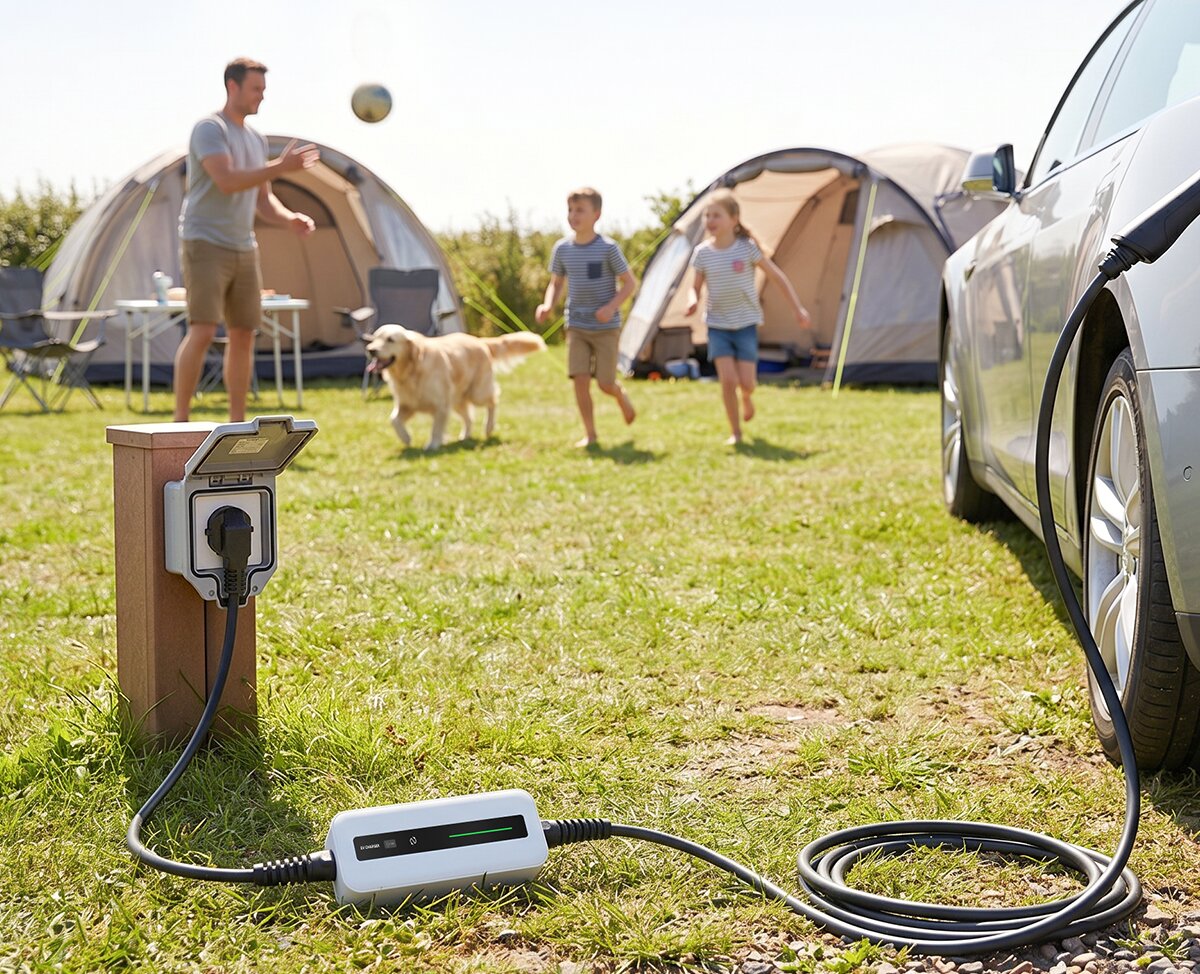
You spend the weekend visiting your parents, who have a house with a standard outdoor socket. Instead of searching for a nearby charging station, you can simply recharge while spending time with family. Perhaps you rent a holiday cottage in the countryside, stay in an Airbnb with private parking, travel to a campsite, or temporarily rent a garage with electrical access.
In all of these situations, a Portable EV Charger allows the vehicle to charge wherever a suitable power supply is available. For drivers without dedicated parking, the most practical charging strategy is that combine the public charging and portable charging. Public charging remains the primary source of daily energy, while a portable charger provides flexibility whenever new charging opportunities appear.
Rather than replacing the public charging network, it helps reduce dependence on it.
⭐⭐Conclusion: Hybrid Charging: The New Normal for European EV Owners
As Europe's charging infrastructure continues to mature, another trend is becoming increasingly clear. More and more EV owners are no longer relying on just one charging solution. Instead, they are building a charging routine around their daily lives.
A typical working week might look something like this.
On weekdays, the vehicle is partially charged at the office using Workplace EV Charging; Back home, a Home EV Charger tops up the battery overnight; During a weekend road trip across France or Germany, the driver uses Public DC Fast Charging along the motorway; A few weeks later, while staying at a holiday home in the countryside, a Portable EV Charger provides convenient overnight charging using an ordinary power outlet.
Each charging method solves a different problem. Instead of competing with one another, these solutions complement each other. This is why more European consumers are asking "What is the best EV charging setup for my lifestyle?" rather than simply searching for Best EV Charger.
The answer is becoming increasingly personal. There is no universal charging solution because there is no universal European lifestyle. They are the ones who build a charging routine around how they actually live, work and travel.
This shift in thinking can gradually and effectively alleviate the charging anxiety. Increasingly, it is about creating a charging ecosystem that provides confidence every day, whether at home, at work, on holiday or on the road.