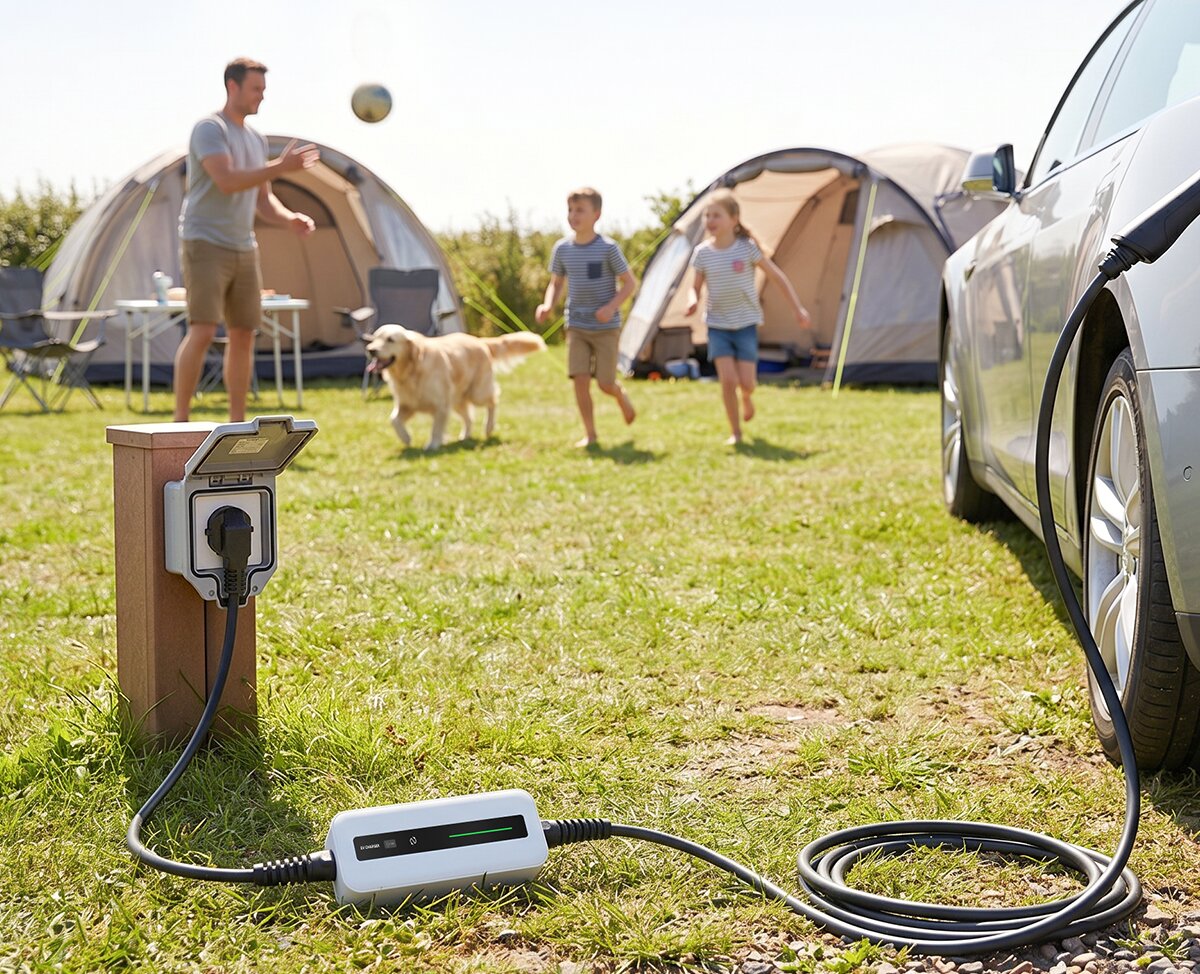
In the previous blog post, we talked about how to choose a used electric vehicle. In this post, we'll continue from there and discuss how to charge your used electric vehicle most cost-effectively after you've chosen it.
Your First Night With the Car: How Will You Charge It?
You've collected the keys.
You've driven home.
Now the excitement begins to feel real.
Then another question appears.
How are you actually going to charge your new electric car tonight?
For many first-time EV owners, this is the moment when they realise that owning an electric vehicle is slightly different from owning a petrol car. Fortunately, it's also much easier than many people expect.
Can You Simply Use a Household Socket?
In many cases, yes. If your vehicle includes its original Mode 2 Charger, you can usually recharge the battery using a standard household socket. For drivers covering relatively short daily distances, this may be perfectly adequate during the first few days—or even the first few months. However, charging from a household socket is generally slower than using a dedicated Home EV Charger.
If you regularly drive longer distances or charge almost every night, you'll probably begin looking for a more convenient solution. This is when you think of home EV charger. You simply plug in when you arrive home and wake up to a fully charged vehicle the next morning. Instead of making a separate trip to refuel, the car charges while you're doing something else.
Which is better, a home EV charging station or a portable EV charger?
There's no single answer that suits everyone. The best charging solution depends on how you use your vehicle, where you park, and how often you charge.
🟡A Portable EV Charger Is Ideal If...
- Rent your home rather than own it.
- Move house frequently.
- Occasionally charge at different locations.
- Drive relatively short daily distances.
- Want a backup charging solution for holidays or emergencies.
For many new EV owners, the original portable charger is enough while they learn their charging habits.
🟡A Wallbox Makes Sense If...
- Have a private driveway or dedicated parking space.
- Charge your vehicle almost every day.
- Plan to keep the vehicle for several years.
- Want a faster, more reliable charging experience.
- Prefer features such as scheduled charging or adjustable charging current (depending on the model).
For many households, a Wallbox quickly becomes as essential as home Wi-Fi—something you stop thinking about because it simply works.
But Which Home EV Charger Should You Choose?
This is where many first-time buyers become confused. Some people assume that buying the highest-power charger automatically means faster charging. Others aren't sure whether they need a 7.4 kW, 11 kW or 22 kW Home EV Charger.
The reality is much simpler. Choosing the right charger isn't about buying the biggest one. It's about choosing one that matches both your vehicle and your home's electrical supply.
The actual charging speed of your vehicle depends on three factors working together:
- Your vehicle's Maximum AC Charging Power.
- Your home's electrical supply.
- The rated power of the Home EV Charger.
Your charging speed will always be limited by whichever of these three reaches its maximum first. Understanding this simple principle can help you avoid buying a charger that's either too powerful to provide any additional benefit—or too limited for your future needs.
Step1️⃣: Check Your Vehicle's Maximum AC Charging Power
Before choosing any Home EV Charger, you should first understand your vehicle's Maximum AC Charging Power. This specification is determined by the vehicle's On-board Charger (OBC), which converts AC electricity from your home into DC electricity that can be stored in the battery. Many first-time EV owners confuse AC Charging with DC Fast Charging. For example, a vehicle advertised with 150 kW DC Fast Charging may only support 11 kW Maximum AC Charging Power at home.
That's completely normal. Public DC charging and home AC charging are two different systems. If you want to know how quickly your car can charge at home, always look for the manufacturer's published Maximum AC Charging Power. How Can You Find It? It's usually easy. You can:
- Check the vehicle's original specification sheet.
- Read the owner's manual.
- Contact the manufacturer using the vehicle's VIN.
- Ask an authorised dealer to confirm the specification. Ask the seller directly: "What is the vehicle's maximum AC charging power?" This question is much more useful than asking "How fast does it charge?" Because many sellers will answer using the vehicle's DC charging speed rather than its AC charging capability.
Step2️⃣: Understand Your Home's Electrical Supply
Even if your vehicle supports faster AC Charging, your home may not. That's why the second part of the decision is understanding your home's electrical supply.
The key questions are:
- Is your property supplied with Single-phase Charging or Three-phase Charging capability?
- How much current is available for EV charging?
- Is there a dedicated circuit available for a Home EV Charger?
- Will your electrical installation support the charger you want to install?
You don't need to memorise electrical formulas. An electrician can confirm these details during a site survey. However, understanding the basics will make choosing the right charger much easier.
Which Home EV Charger Is Right for You?
Every home is different. Every vehicle is different. The examples below represent some of the most common situations European EV owners encounter. If one of them looks similar to your own situation, it can provide a good starting point.
🟢Scenario 1
Vehicle Maximum AC Charging Power: 7.4 kW (Single-phase)
Home Electrical Supply
Single-phase 230 V
Maximum current available for EV charging: 32 A
Recommended Home EV Charger: 7.4 kW Wallbox
Actual Charging Speed: Approximately 7.4 kW.
This is an ideal match.
The vehicle, the electrical supply and the charger are all capable of delivering the same charging power.
What If You Install an 11 kW or 22 kW Wallbox?
The vehicle will still charge at approximately 7.4 kW.
Although the charger is capable of delivering more power, the vehicle's Maximum AC Charging Power remains 7.4 kW.
Installing a larger charger will not reduce charging time for this vehicle.
🟢Scenario 2
Vehicle Maximum AC Charging Power: 11 kW (Three-phase)
Home Electrical Supply
Three-phase 400 V
Maximum current available for EV charging: 16A per phase
Recommended Home EV Charger: 11 kW Wallbox
Actual Charging Speed: Approximately 11 kW.
This is another perfectly matched installation.
The vehicle can utilise the full output of the charger, and the home's electrical supply supports it without limitation.
What If You Install a 22 kW Wallbox?
There will be virtually no improvement in charging speed.
Your vehicle already reaches its maximum AC Charging capability at 11 kW.
A larger charger won't make it charge any faster.
🟢Scenario 3
Vehicle Maximum AC Charging Power: 11 kW (Three-phase)
Maximum Single-phase AC Charging: Approximately 3.7 kW
Home Electrical Supply
Single-phase 230 V
Maximum current available for EV charging: 32 A
Recommended Home EV Charger: 7.4 kW Wallbox with adjustable charging current.
Actual Charging Speed: Approximately 3.7 kW.
This is one of the situations that surprises many first-time EV owners.
Although the home can supply up to 32 A, the vehicle itself only accepts approximately 3.7 kW when connected to a single-phase supply.
In this case, the limitation comes from the vehicle—not the charger or the home's electrical installation.
Would a 22 kW Wallbox Help?
No.
The vehicle's own Maximum AC Charging Power under single-phase charging remains the limiting factor.
Replacing the charger with a higher-power model won't increase charging speed.
🔔One Simple Rule to Remember
When choosing a Home EV Charger, don't start by asking: "Which charger is the fastest?"
Instead, ask: "Which charger matches both my vehicle and my home's electrical supply?"
That's the difference between buying the biggest charger—and buying the right charger.
Many new EV owners discover that a correctly matched 7.4 kW Wallbox performs better for their situation than an oversized 22 kW Wallbox that can never be fully utilised.
Understanding your vehicle's Maximum AC Charging Power before purchasing a charger can save money, avoid unnecessary upgrades, and ensure your charging setup works exactly as expected from day one.
🟢Scenario 4
Vehicle Maximum AC Charging Power: 22 kW (Three-phase)
Home Electrical Supply
Three-phase 400 V
Maximum current available for EV charging: 32A per phase
Recommended Home EV Charger: 22kW Wallbox
Actual Charging Speed: Approximately 22kW.
This is the ideal scenario.Your vehicle, your home's electrical supply and your Home EV Charger are all capable of operating at the same power level, allowing the vehicle to achieve its maximum AC Charging performance.
This setup is commonly found in properties with a full three-phase electrical supply and is particularly beneficial for drivers who cover high annual mileage or want to minimise charging time between journeys.
🟢Scenario 5
Vehicle Maximum AC Charging Power: 22kW (Three-phase)
Home Electrical Supply
Three-phase 400V
Maximum current available for EV charging: 16A per phase
Recommended Home EV Charger: 11KW Wallbox
Actual Charging Speed: Approximately 11 kW.
This situation is more common than many people realise.
Although the vehicle is capable of accepting up to 22 kW AC Charging, the home's electrical supply is only able to provide enough power for approximately 11 kW.
In other words, your home—not your vehicle—is the limiting factor.
Would Installing a 22 kW Wallbox Make Charging Faster?
No.
The charger cannot deliver power that your home's electrical installation cannot supply.
Even with a 22 kW Wallbox installed, charging would still be limited to approximately 11 kW. Unless your property is upgraded to provide additional electrical capacity, investing in a larger charger offers little practical benefit.
🟢Scenario 6
Vehicle Maximum AC Charging Power: 7.4kW (Single-phase)
Home Electrical Supply
Three-phase 400V
Maximum current available for EV charging: 32A per phase
Recommended Home EV Charger: 7.4 kW Wallbox or A smart 22 kW Wallbox if you plan to upgrade to a future vehicle with a higher Maximum AC Charging Power.
Actual Charging Speed: Approximately 7.4 kW.
Although your home has a three-phase electrical supply capable of supporting much faster charging, your current vehicle only supports 7.4 kW AC Charging. For today's vehicle, installing a 22 kW Wallbox will not reduce charging time.
However, if you expect to replace your vehicle within the next few years with one that supports 11 kW or 22 kW Maximum AC Charging Power, installing a higher-capacity smart charger now could reduce installation costs later and avoid replacing the charger a second time. When planning for the future, it's worth considering not only the car you own today, but also the one you expect to own next.
Buying the Right Charger Is About Compatibility, Not Maximum Power. One of the biggest misconceptions surrounding EV charging is that "bigger is always better." The smarter approach is to choose a charging solution that matches your current needs while leaving reasonable room for future upgrades if you expect to change vehicles.
Compatibility almost always matters more than headline power figures.
Your Used EV Journey Doesn't End After You Buy the Car. Buying a Used EV is only the beginning of your electric driving journey. Choosing the right model, checking its condition and confirming the charging accessories are included will help you make a confident purchase. But enjoying EV ownership over the next five or ten years depends just as much on how you charge the vehicle every day. Understanding your vehicle's Maximum AC Charging Power, knowing the capabilities of your home's electrical supply and selecting the right Home EV Charger will make charging simpler, safer and far more convenient.
The goal is to build a charging setup that fits your vehicle, your home and your lifestyle.
Get those three things right, and every morning begins the same way: You unplug your car, start your journey, and leave home with a full battery—without ever needing to stop at a petrol station again.